By MBANUGO Stores | mbanugostores.com
Picture this: your child has been staring at a textbook for forty minutes. Their eyes are glazing over. They’re technically “reading” but absolutely nothing is going in. You’ve tried different approaches. You’ve explained the concept three different ways. And they’re still stuck.
Now picture this instead: that same child, thirty minutes into a board game — laser focused, thinking carefully, making decisions, laughing, competing, and absorbing concepts they couldn’t grasp from a textbook in forty minutes — without even realising they’re learning.
That is the magic of educational board games. And it is not magic at all — it is science. Decades of research in child development and educational psychology consistently show that children learn faster, retain more, and engage more deeply when learning happens through play.
Nigerian parents and teachers are beginning to wake up to this truth in a significant way. And the timing couldn’t be better.
This post covers the best educational board games for Nigerian primary school children — what they teach, what age they’re suited for, and why every parent and teacher reading this should be taking this more seriously than they currently are.
Let’s get into it. 🔥
Why Educational Board Games Belong in Nigerian Schools and Homes
Before the game list, let’s address the elephant in the room — because some Nigerian parents and teachers will read “board games” and immediately think: “That’s for fun, not for learning. My child needs to focus on their books.”
With respect — this thinking is holding our children back. Here’s why.
Children learn through play. This is not an opinion — it is one of the most well-established facts in developmental psychology. The brain of a primary school child is wired to learn through active engagement, social interaction, problem-solving, and play. Passive reading and memorisation work against how young brains actually process and retain information.
Nigerian schools are exam-focused but not always learning-focused. The pressure to pass FIRST SCHOOL LEAVING CERTIFICATE and Common Entrance exams pushes schools toward rote memorisation rather than deep understanding. Educational board games develop the underlying skills — critical thinking, vocabulary, numeracy, logic — that make a child genuinely capable, not just exam-ready.
Children who play educational games develop real advantages. A child who regularly plays Scrabble has a larger vocabulary than their peers. A child who plays Chess thinks more strategically. A child who plays Monopoly Junior understands money and numbers better. These aren’t marginal advantages — they compound over years of schooling and beyond.
The best part? The child just thinks they’re having fun. 😄
🎲 The Best Educational Board Games for Nigerian Primary School Children
1. SCRABBLE JUNIOR — Vocabulary, Spelling, Literacy 🔤
What it teaches: Letters, spelling, vocabulary, reading, word recognition
Best age: 5–10 years (Junior edition), 8+ years (Standard edition)
Why Nigerian primary school children need this:
English language proficiency is one of the most important academic advantages a Nigerian child can have. It affects performance across every subject — from comprehension to essay writing to understanding exam questions clearly.
Scrabble Junior is designed specifically for younger players, with a double-sided board that starts with simple word-matching for beginners and progresses to standard Scrabble play as the child develops. Children build words, learn spellings, and expand their vocabulary — all while competing and having fun.
For primary school children struggling with English spelling and reading — or for children who are already strong readers and want a challenge — Scrabble Junior is one of the highest-value educational investments a parent or school can make.
For teachers: A classroom set of Scrabble Junior boards can transform English Language periods into genuinely engaging sessions. Children who dread reading exercises will fight over who gets to play next.
Skills developed:
- English vocabulary and spelling
- Letter recognition and phonics
- Strategic thinking (standard edition)
- Turn-taking and social skills
2. CHESS — Critical Thinking, Strategy, Patience ♟️
What it teaches: Logic, strategic planning, problem-solving, concentration, emotional regulation
Best age: 6 years and above (basic concepts), 8+ years (full strategic play)
Why Nigerian primary school children need this:
Chess is not just a game — it is one of the most powerful tools for developing young minds ever created. And Nigeria’s rich chess culture, rooted in its academic communities (Nsukka’s UNN chess scene being a prime example), makes it a particularly relevant choice.
Research across multiple countries consistently shows that children who learn chess perform better in mathematics, read at higher levels, and show improved concentration and problem-solving ability compared to their non-chess-playing peers. UNESCO recognised chess as a valuable educational tool and recommended its inclusion in school curricula.
For a Nigerian primary school child, learning chess develops:
- Forward planning — Thinking about consequences before acting (valuable in academics and life)
- Patience — Slowing down and thinking carefully before making a move
- Resilience — Handling losses gracefully and learning from mistakes
- Concentration — Sustaining focus for extended periods
- Mathematical thinking — Pattern recognition, spatial reasoning, calculation
For teachers and school administrators: Chess clubs in Nigerian primary schools are growing. Setting up a chess club costs very little — just a set of boards — but the academic and character benefits for students are significant and well-documented.
For parents: Teaching your child chess is one of the most valuable gifts you can give their developing mind. Start with the basic piece movements and rules, play casually, and let the learning deepen naturally over time.
3. SNAKES AND LADDERS — Numbers, Counting, Turn-Taking 🎲
What it teaches: Number recognition, counting, turn-taking, emotional regulation, basic probability concepts
Best age: 3–7 years
Why Nigerian primary school children need this:
Snakes and Ladders is one of the most underestimated educational tools for young Nigerian children — and one of the most accessible.
For children in nursery and lower primary (Primary 1–2), Snakes and Ladders builds fundamental number skills in the most natural, enjoyable way possible. Children count spaces, recognise numbers on the board and dice, and begin to understand concepts like “more than” and “less than” — all without it feeling like a lesson.
Beyond numeracy, Snakes and Ladders is one of the best tools for teaching young children emotional regulation — the critical life skill of handling both winning and losing with grace. When a child’s counter slides down a long snake right before the finish line, they experience disappointment in a safe, low-stakes environment and learn to manage it. This emotional resilience is a skill they’ll use every day for the rest of their lives.
For teachers: Perfect for Maths corners and play-based learning periods in Primary 1 and 2. Requires zero explanation for most Nigerian children — they’ve seen it at home.
For parents: A brilliant first board game for children aged 3–5 who are ready to start playing but not yet ready for more complex games.
4. LUDO — Social Skills, Numeracy, Strategic Thinking 🔴🟡🟢🔵
What it teaches: Counting, basic strategy, social interaction, turn-taking, emotional management
Best age: 5 years and above
Why Nigerian primary school children need this:
Ludo is Nigeria’s most beloved board game — and for primary school children, it is genuinely educational in ways that often go unrecognised.
Every Ludo game involves constant counting (moving pieces the exact number of spaces shown on the dice), basic strategic decisions (which piece to move when you have a choice), social negotiation (playing with others, managing reactions to wins and losses), and emotional regulation (dealing with the devastation of being sent back to base 😄).
For children in the 5–9 age range, Ludo provides all of these developmental benefits wrapped in a game they already love and are motivated to play. The learning happens without resistance because the fun is so immediate and genuine.
For teachers: A Ludo set in the classroom creates opportunities for numeracy practice during play periods, social skill development, and genuine peer interaction across ability levels.
For parents: Already a fixture in most Nigerian homes — but worth playing intentionally with your children, narrating the counting and decision-making out loud to reinforce the educational value.
5. MONOPOLY JUNIOR — Financial Literacy, Numeracy, Decision-Making 🏠💰
What it teaches: Money handling, basic arithmetic, decision-making, property concepts, financial consequences
Best age: 5–8 years (Junior edition), 8+ years (Standard edition)
Why Nigerian primary school children need this:
Financial literacy is one of the most critically underdeveloped skills in Nigerian education — at every level. Most Nigerian adults were never taught how money actually works, how to manage it, how to save it, or how to make decisions with it.
Monopoly Junior introduces these concepts in a context that primary school children find completely engaging. They handle money (the game currency), make buying decisions, collect rent, manage their finances, and experience the consequences of financial choices — all within the safety and fun of a game.
Children who play Monopoly regularly develop:
- Numeracy skills — Counting money, making change, adding and subtracting in context
- Decision-making — Weighing options and choosing strategically
- Financial concepts — Ownership, rent, income, bankruptcy — understood experientially, not just theoretically
- Patience and long-term thinking — Monopoly rewards strategic patience over impulsive play
For teachers: Excellent for introducing basic economics concepts in upper primary classes (Primary 4–6) in an engaging, hands-on way.
For parents: One of the most valuable educational games you can put in front of a primary school child who is approaching secondary school and needs to begin understanding how the adult world of money and property works.
6. WORD BUILDING CARD GAMES — Phonics, Literacy, Language 🃏
What it teaches: Phonics, letter combinations, word building, reading readiness
Best age: 4–8 years
Why Nigerian primary school children need this:
For younger primary school children who are still developing literacy skills, simple word-building card games that focus on phonics and letter combinations are powerful learning tools.
These games make the process of learning to read and build words feel like play — removing the anxiety and frustration that many children feel around reading instruction and replacing it with excitement and motivation.
For children with reading difficulties or slower literacy development, word-building games can be transformative — providing a low-pressure, enjoyable way to practise the skills they struggle with in a classroom setting.
🏫 A Message to Nigerian Primary School Teachers
If you are a primary school teacher reading this — this section is specifically for you.
You are managing large classes, limited resources, and enormous pressure to produce results for national examinations. We understand that reality completely.
But here’s what educational board games can do for your classroom that textbooks and rote teaching cannot:
They engage the disengaged. The child who cannot sit still for a lesson will focus intensely on a board game. The child who “doesn’t like school” will arrive early to play Chess club. Board games reach children that traditional teaching methods miss.
They create peer learning opportunities. When children play together, stronger players naturally explain rules and strategies to weaker ones. This peer teaching is extraordinarily effective — children often understand concepts better when explained by a classmate than by an adult.
They make differentiation easy. You can have Primary 3 and Primary 5 students playing Scrabble together productively — each at their own level, both benefiting and learning from each other.
They build classroom community. Board games create shared experiences, shared laughter, and shared investment in outcomes. A class that plays together bonds together — and a class that bonds performs better academically.
MBANUGO Stores welcomes school bulk orders for educational board games. Whether you’re setting up a classroom game corner, a school chess club, or stocking a school library with educational games — contact the store for school pricing and bulk availability.
👨👩👧 A Message to Nigerian Parents
Your child’s education does not only happen in a school building. It happens in your home. At your dining table. On Sunday afternoons when the family is together.
Every time you sit down to play a board game with your child, you are:
✅ Building their vocabulary and numeracy without homework pressure
✅ Teaching them to think strategically and manage setbacks
✅ Showing them that learning is something the family does together — not something that happens in isolation
✅ Creating memories and family bonds that outlast any specific exam result
You don’t have to choose between education and fun for your child. The best educational board games give you both — simultaneously, effortlessly, and joyfully.
🎯 Quick Guide — Which Game for Which Age and Goal?
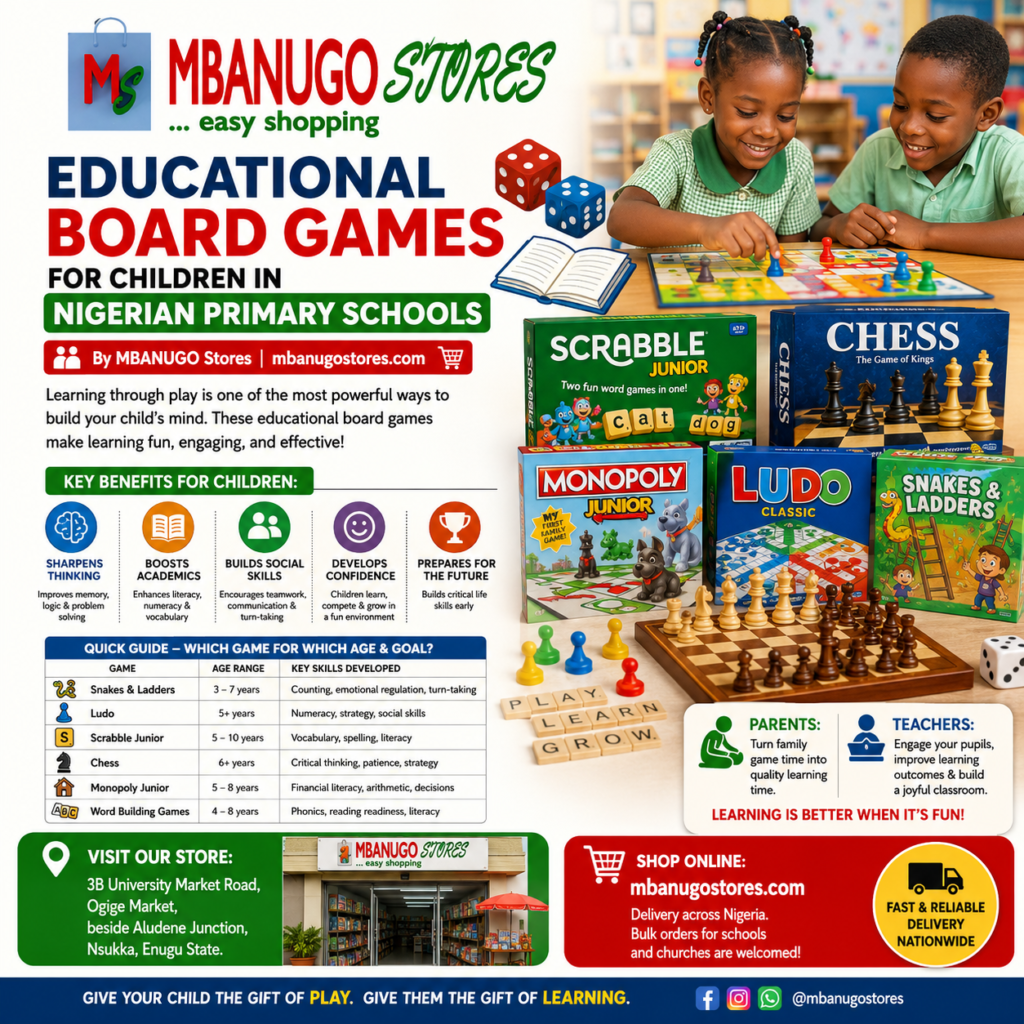
| Game | Age Range | Key Skills Developed |
|---|---|---|
| Snakes & Ladders | 3–7 years | Counting, emotional regulation, turn-taking |
| Ludo | 5+ years | Numeracy, strategy, social skills |
| Scrabble Junior | 5–10 years | Vocabulary, spelling, literacy |
| Chess | 6+ years | Critical thinking, patience, strategy |
| Monopoly Junior | 5–8 years | Financial literacy, arithmetic, decisions |
| Word Building Games | 4–8 years | Phonics, reading readiness, literacy |
Where to Buy Educational Board Games in Nsukka — and Online
MBANUGO Stores stocks educational board games for Nigerian primary school children — from classic favourites like Ludo, Scrabble, and Chess to Snakes and Ladders and more. Everything you need to turn game time into learning time, whether at home or in the classroom.
🏪 Visit the Store:
📍 3B University Market Road, Ogige Market,
beside Aludene Junction, Nsukka, Enugu State.
Walk in and speak with the team about the age range you’re buying for and the skills you want to develop. Whether you’re a parent buying for one child or a teacher equipping a whole classroom, MBANUGO Stores will help you find the right games at the right price.
📱 Order Online — Delivery Across Nigeria:
🌐 mbanugostores.com
Outside Nsukka? Shop the full board games range online at mbanugostores.com and get delivery anywhere in Nigeria. Perfect for teachers ordering for schools and parents who want to shop without the trip.
Bulk orders for schools and churches are welcomed — contact the store directly for availability and pricing.
Final Word — Play Is How Children Learn Best 🎲❤️
The Nigerian child sitting in front of you — your student, your son, your daughter — is not a vessel to be filled with information. They are a curious, creative, capable human being whose brain is designed to learn through engagement, interaction, and play.
Educational board games meet them exactly where they are. They speak the language children naturally speak — the language of fun, challenge, competition, and discovery.
Every Chess move your child makes is a lesson in strategy. Every Scrabble word they form is a vocabulary lesson. Every Ludo game they play is a lesson in resilience. Every Monopoly decision is a lesson in financial thinking.
The classroom is important. Books are important. But the game board? The game board might be where the real learning happens.
Invest in yours today. Head to MBANUGO Stores at Ogige Market, Nsukka or visit mbanugostores.com — and bring the joy of learning through play into your home and classroom.
Because when children play well, they learn well. And when they learn well, they become everything we hope they’ll be. 🙏🎲
📍 Visit us: 3B University Market Road, Ogige Market, beside Aludene Junction, Nsukka, Enugu State
🌐 Shop online: mbanugostores.com
Are you a teacher or parent in Nigeria who believes in learning through play? Share this post in your school staff group, PTA WhatsApp group, or parenting community — let’s get more Nigerian children learning through games. 🎲📚🔁