
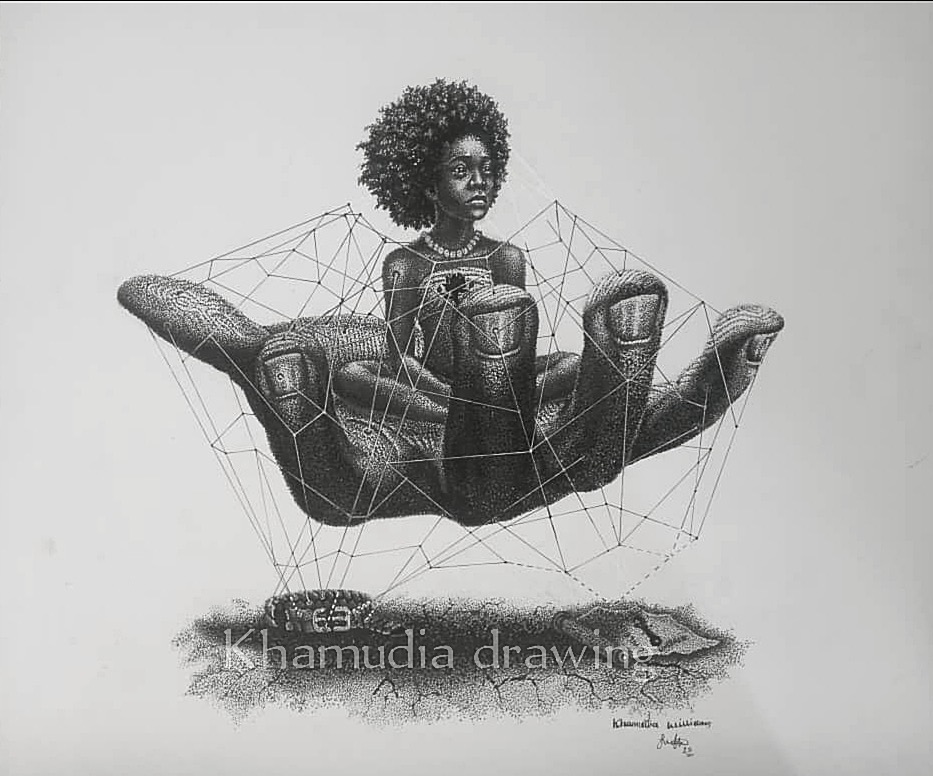
Hyperrealism as Inquiry: Inside the Mind of a Nigerian Visual Storyteller
There is a quiet intensity in Khamudia Williams’ work…an atmosphere where realism exists only on the surface, while meaning settles deeper beneath it.
At first glance, his drawings resemble photographs. But the longer one looks, the more the images begin to shift. Faces seem to hold emotional residue beyond likeness, and figures appear suspended between presence and interpretation. His work does not insist on being understood immediately…it invites prolonged attention.
For Khamudia Williams, drawing is not replication. It is inquiry.
ARTIST PROFILE
Name: Khamudia Williams
Medium: Charcoal and Graphite
Style: Hyperrealism, Surrealism, Symbolic Visual Storytelling
Focus: Human behavior, contradiction, social reflection
Location: Nigeria
ART AS A LANGUAGE OF QUESTIONING
Khamudia’s journey into art did not begin as ambition, but as expression.
In Junior Secondary School, drawing served as a private emotional outlet…a way of processing thoughts that could not easily be spoken. Over time, that quiet practice evolved. What began as expression gradually became communication, and eventually, a structured visual language.
Today, his work sits between realism and conceptual inquiry, where observation, belief systems, and human contradiction become central material.
In his words, art is not decoration. It is a medium for questioning what language cannot fully contain.
“My aim isn’t just to create beautiful drawings. I want images that invoke thoughts and conversations.”
This idea shapes the foundation of his practice: clarity is less important than curiosity.
HUMAN BEHAVIOR AS FOUNDATION
Rather than drawing influence from established art movements, Khamudia builds his work from observation.
He is particularly drawn to contradictions in human behavior…the distance between what people claim to believe and how they actually behave. For him, this tension becomes a source of meaning.
His environment also plays a continuous role. Nigerian society, with its complexity, resilience, and unresolved tensions, forms an ongoing backdrop to his visual thinking.
His work does not separate art from life. It absorbs it.
THE CREATIVE PROCESS: THINKING BEFORE DRAWING
Khamudia’s process is primarily internal before it becomes visual.
Each work begins as a constructed mental image. Composition, emotion, and message are first mapped in the mind before any physical mark is made.
From there, reference materials are gathered…sometimes through photography, sometimes through combining multiple visual sources, and occasionally through working with people around him as visual references.
Only after this mental construction does drawing begin.
He describes this conceptual stage as the most significant part of his work.
The drawing itself becomes execution. The thinking is the foundation.
MATERIALS AND VISUAL LANGUAGE
Khamudia works primarily with charcoal and graphite, chosen for their expressive range rather than complexity.
Graphite provides precision and control. Charcoal introduces depth and atmosphere. Together, they create a balance between clarity and emotional weight.
His visual language moves across three interconnected registers:
- Hyperrealism as familiarity
- Surrealism as abstraction
- Symbolism as hidden meaning
The result is imagery that feels real, yet emotionally unsettled.
SELECTED WORKS (VISUAL STUDIES)
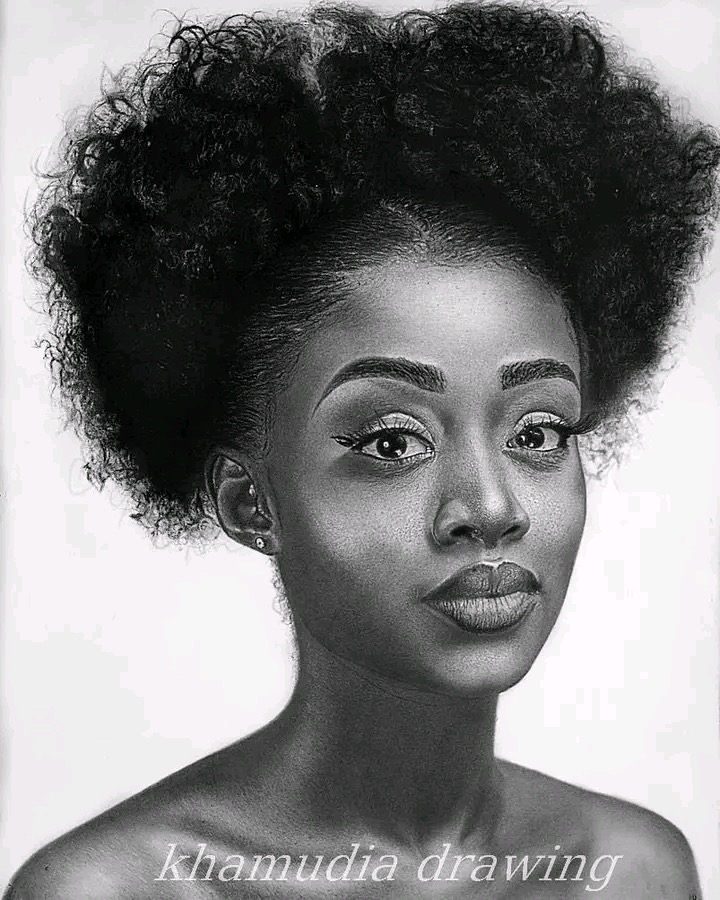
One of his works presents a highly detailed human face rendered with precision, yet partially interrupted by subtle obscurity. The tension lies not in distortion, but in what is withheld from full visibility.
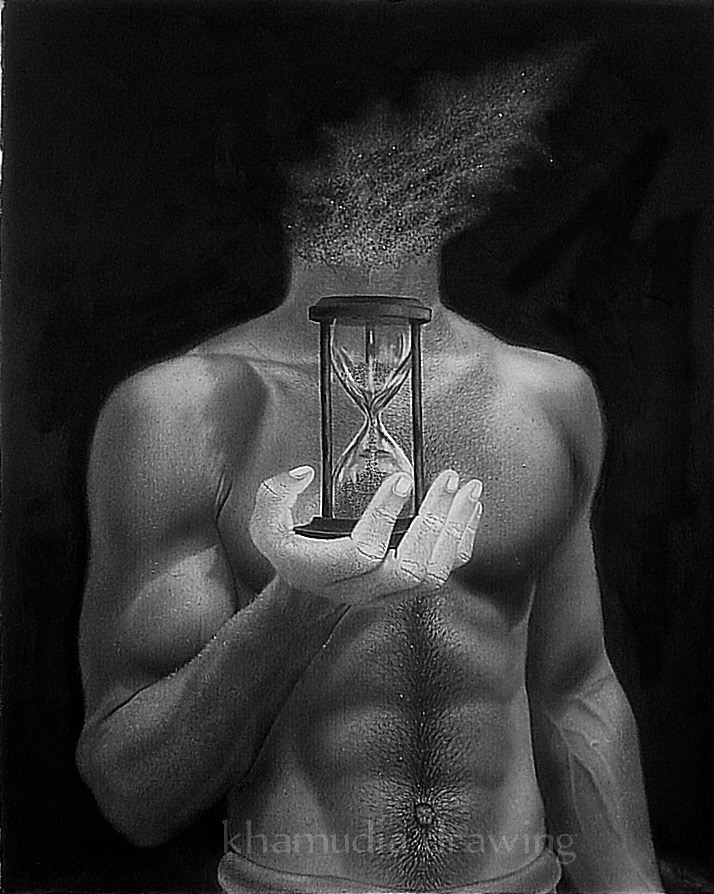
Another composition features a human figure engaged with an hourglass form, suggesting an intimate relationship between presence, time, and fragility.
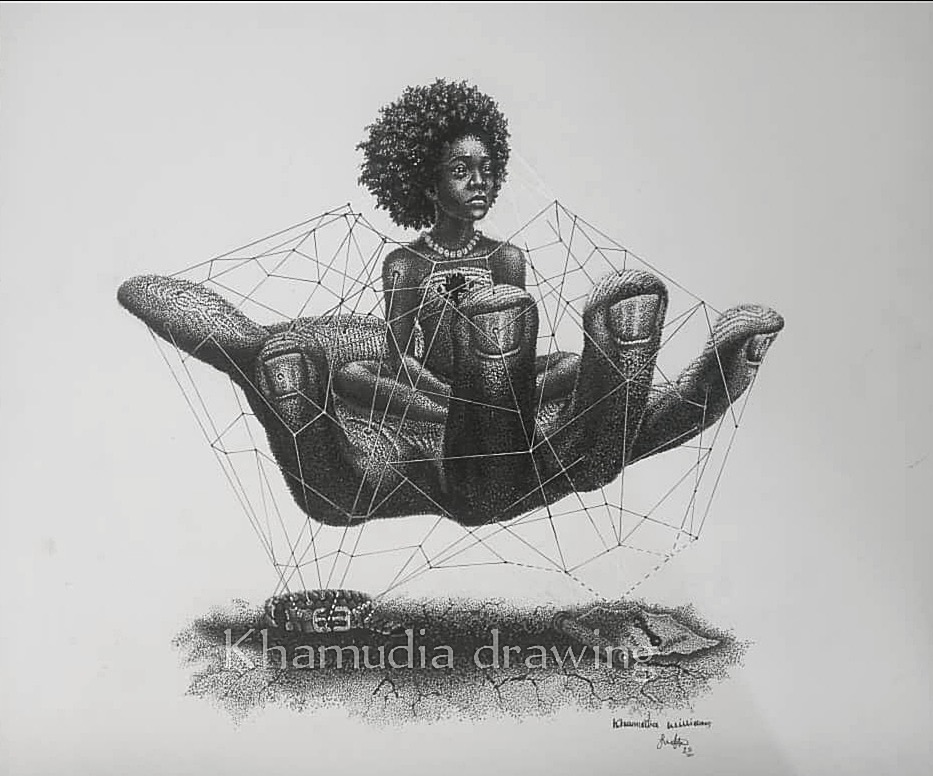
In another piece, a suspended human form exists within an undefined spatial structure, connected through linear elements that imply psychological or emotional networks rather than physical reality.
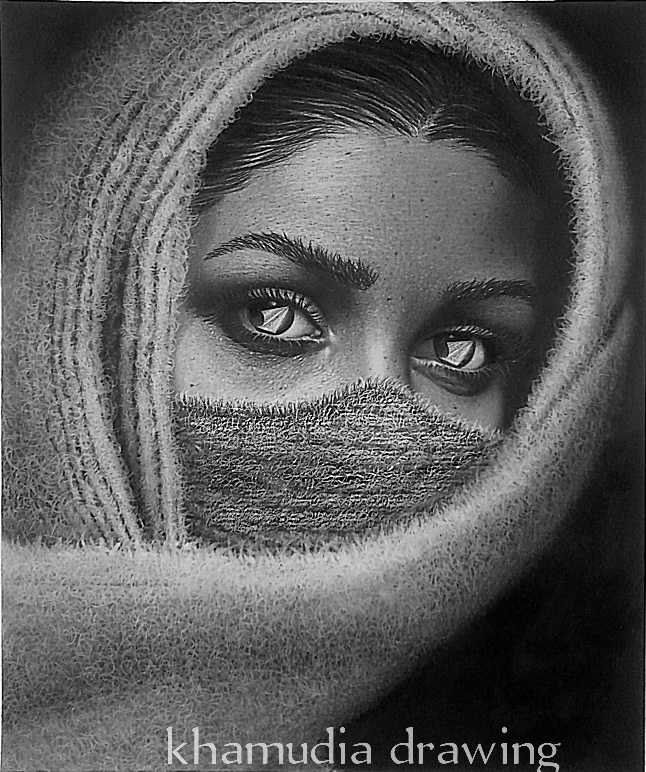
A separate portrait study focuses on quiet introspection. The subject appears grounded in realism, yet the emotional atmosphere suggests internal depth beyond what is visible.
Across these works, realism is not the endpoint…it is the entry point into interpretation.
ART AS SOCIAL AND PHILOSOPHICAL REFLECTION
For Khamudia, art carries responsibility…not as activism in a direct sense, but as reflection.
His work engages with themes of injustice, memory, cultural identity, and emotional truth. Rather than offering conclusions, it creates space for interpretation.
“Art is a medium I use to question human behavior, belief systems, power, and society.”
Meaning is not fixed in his work. It remains open, deliberately.
He avoids over-explaining his pieces, allowing viewers to complete the interpretation through their own perception.
CHALLENGES AND ARTISTIC VOICE
One of his ongoing challenges is the development of a distinct artistic voice in a visually saturated environment.
Rather than imitation, his focus is refinement…building a language that is recognizably his own.
This process is still unfolding. He does not present completion, but progression.
COMMUNITY AND FUTURE DIRECTION
Khamudia expresses a strong desire for stronger artistic collaboration within Nigeria.
He envisions spaces where experimentation is not constrained by fear of failure, but encouraged as part of growth.
In his view, the absence of such environments limits creative expansion.
His direction extends beyond personal practice into collective artistic development.
WHAT SUSTAINS HIS PRACTICE
At the center of his work is curiosity.
Not inspiration as an abstract idea, but curiosity as a continuous process of questioning.
Each question leads to observation. Each observation leads to research. Each research phase leads back to drawing.
It is a cycle that never settles.
“There is always a question to ask, another idea to explore, and truths to uncover.”
CLOSING NOTE
Khamudia Williams’ work does not simplify reality. It holds it open.
Through realism and symbolism, his drawings exist in a space where recognition ends and interpretation begins. In that space, the viewer is not guided toward answers, but toward reflection.
That is where his work exists.
And that is where it continues to evolve.
You can reach Khamudia via