By MBANUGO Stores | mbanugostores.com
So you got into the Fine Arts programme. Or Industrial Design. Or Architecture. Or Creative Arts education. Or you’re in secondary school taking Fine Art as a subject and your teacher has given you a list that looks like it was written in a different language.
Whatever brought you here — welcome. You’re in the right place.
Being an art student in Nigeria is one of the most exciting and demanding academic experiences there is. You’re being trained to see the world differently, to translate what you see into something others can experience, and to develop a creative voice that is entirely your own. That journey is incredible.
But it starts with the right tools.
And here’s where a lot of Nigerian art students — especially those just starting out — make a critical mistake. They either buy everything on every list they find online (mostly written for students in the UK or US, with supplies that aren’t even available in Nigeria), or they buy the cheapest versions of everything and spend the first semester frustrated by supplies that don’t perform.
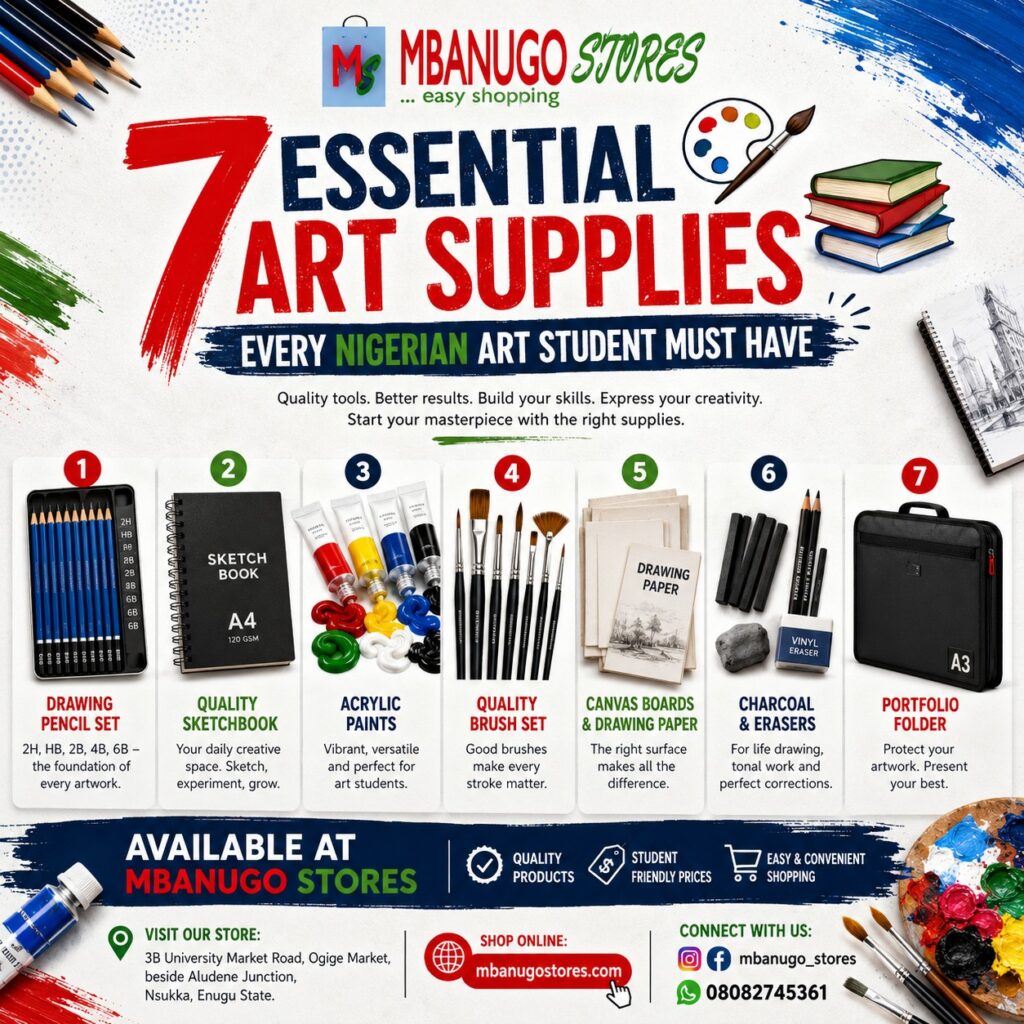
This post gives you the real list. The seven art supplies that every Nigerian art student genuinely must have — what they are, what to look for, and where to get quality versions right here in Nsukka or online.
Let’s go. 🔥
Before the List — A Word on Quality
Here is the one piece of advice that will save you the most money, frustration, and wasted time as an art student in Nigeria:
Buy fewer items of better quality rather than many items of poor quality.
A cheap set of twenty pencils that scratch, skip, and break will hold your work back and frustrate you into giving up on a piece before it’s done. Six quality pencils of different grades will give you control, consistency, and results you’re actually proud of.
Quality supplies don’t just produce better work — they make the process of creating better. And for an art student who will spend hundreds of hours at their desk or easel over the course of their programme, that process matters enormously.
Now — the list. 👇
1. ✏️ A Complete Drawing Pencil Set — The Foundation of Everything
If there is one art supply that every Nigerian art student must own before anything else, it is a quality set of drawing pencils. Everything in art begins with drawing. Every painting is underpinned by a sketch. Every design begins with a line.
Your pencil set is not supporting your art. It is your art, at its most fundamental level.
Understanding the Pencil Grading System
Pencils are graded on a scale from H (hard) to B (black/soft):
H pencils (H, 2H, 3H, 4H) — Hard lead, light marks, precise lines. Used for initial sketching, technical drawing, fine architectural lines, and any work requiring light, erasable marks that won’t indent the paper.
HB — The middle ground. Firm enough for general writing, soft enough for sketching. The everyday all-rounder that most people start with.
B pencils (B, 2B, 3B, 4B, 6B, 8B) — Soft lead, dark marks, expressive strokes. The darker the B, the softer and more expressive the pencil. These are for shading, tonal work, life drawing, and the kind of rich, velvety dark areas that make a drawing come alive.
Your essential range as an art student: 2H, HB, 2B, 4B, 6B — this covers everything from light initial sketching to deep, rich shading across virtually every art assignment you’ll face.
What to Look For
- Consistent, smooth lead that doesn’t scratch or skip across the paper
- Clean, even sharpening without the lead crumbling or breaking
- A quality brand that maintains consistent hardness across the range
- Comfortable barrel — you’ll hold this pencil for hours at a time
Pro Tip for Nigerian Art Students
Keep your pencils sharp. A blunt pencil gives you imprecise, uncontrolled marks — and you’ll find yourself pressing harder to compensate, which indents the paper and limits your ability to erase or blend. Sharpen regularly. A good pencil sharpener (or a craft knife for greater control) is part of your essential kit.
👉 Shop drawing pencils at mbanugostores.com
2. 📓 A Quality Sketchbook — Your Most Important Art Tool
After your pencils, your sketchbook is the most essential item in your art student kit. Not a random exercise book, not loose sheets of paper — a proper, dedicated sketchbook.
Here’s why this matters so much: your sketchbook is where you become an artist.
Not in the final assignment. Not in the finished piece. In the sketchbook — in the daily practice, the experiments that don’t work, the studies that teach you something, the pages where you push yourself without the pressure of a grade.
Every great artist in history kept sketchbooks. Every one of them filled them consistently. The sketchbook is where the magic actually happens — and Nigerian art students who treat their sketchbook as a serious daily practice consistently outperform those who don’t.
What to Look For in an Art Student Sketchbook
Paper weight: Minimum 120 GSM for a general drawing sketchbook. If you plan to use watercolour, ink washes, or any wet media in your sketchbook, go to 200 GSM or above — lighter paper will buckle and warp.
Size: A4 is the most versatile size for most art students — large enough to work on compositions and studies, manageable enough to carry everywhere. Get an A3 sketchbook separately for larger studies and layout work.
Binding: A lay-flat binding is important for comfortable working. Spiral-bound sketchbooks lay completely flat and allow you to work across double pages. Quality sewn bindings also work well. Avoid cheap perfect-bound sketchbooks whose spines crack after a few weeks of heavy use.
Page texture: Slightly textured (not completely smooth) paper is best for most drawing media — it gives your pencil and charcoal something to grip. For pure ink illustration, smooth paper produces cleaner lines.
How many sketchbooks do you need?
At minimum, two: one smaller A5 or A4 sketchbook that you carry everywhere for quick studies and ideas, and one larger A3 or A4 sketchbook that lives in your studio or study space for more developed work. Many serious art students keep three or more running simultaneously.
Use Your Sketchbook Daily
This is the piece of advice that separates good art students from great ones. Draw every day — not because you have to, but because daily practice builds the visual language and hand-eye coordination that make everything else in your programme easier. Even ten minutes of sketching from observation on a busy day is better than nothing.
Your sketchbook is a record of your development as an artist. Flip back through a sketchbook from six months ago and the growth you see will motivate you to keep going.
👉 Shop sketchbooks at mbanugostores.com
3. 🎨 Acrylic Paints — Your Versatile Painting Medium
For Nigerian art students specifically, acrylic paint is the recommended starting painting medium — and here’s why.
Acrylics are water-based, which means no solvents, no toxic fumes, and easy cleanup with just water. In Nigerian hostel rooms, student apartments, and home studios that often lack proper ventilation — this matters enormously. Oil paint’s solvents require serious ventilation to use safely. Acrylics do not.
Beyond safety and convenience, acrylics are genuinely powerful. They dry fast — vital for art students on assignment deadlines who can’t wait days between layers. They work on canvas, paper, board, and wood. They can be thinned to watercolour-like washes or used thick for impasto texture. The range of effects possible with quality acrylics is extraordinary.
Student Grade vs. Artist Grade — Which Should You Buy?
This is one of the most important decisions you’ll make as a beginning art student.
Student-grade acrylics have more filler and less pigment. Colours are less vivid, less lightfast (they fade faster), and less consistent. They’re cheaper — but they produce work that looks cheaper.
Artist-grade acrylics have higher pigment concentration, richer colour, better lightfastness, and more consistent performance across the range. They cost more per tube — but you need less paint to achieve the colour you want, so the price difference is smaller than it appears.
Recommendation for art students: Start with artist-grade acrylics in a focused core palette rather than a large student-grade set. Ten to twelve artist-grade colours — the primaries, secondary colours, white, and black — mixed intelligently will produce every colour you need for most assignments.
Your Core Acrylic Palette
- Titanium White
- Ivory Black
- Cadmium Red (or Naphthol Red)
- Cadmium Yellow (or Hansa Yellow)
- Ultramarine Blue
- Phthalo Blue
- Burnt Sienna
- Raw Umber
- Viridian Green
- Yellow Ochre
These ten colours, mixed skillfully, will produce virtually any colour you encounter in your assignments.
👉 Shop acrylic paints at mbanugostores.com
4. 🖌️ A Quality Brush Set — The Bridge Between Paint and Canvas
Your brushes are the tools that carry paint from your palette to your surface. They are not interchangeable with bad alternatives — the quality of your brushes directly affects the quality of your marks, your ability to control paint, and the professional finish of your work.
Many Nigerian art students buy large, cheap brush sets — 20 brushes for a low price — and spend the semester fighting brushes that shed hairs into their paint, lose their shape after the second wash, and refuse to hold a proper point or edge.
Buy fewer, better brushes. Six quality brushes will serve you better than twenty cheap ones.
The Essential Art Student Brush Kit
Flat brush, large (size 10–12): For covering large areas of canvas quickly, creating bold backgrounds, and applying gesso.
Flat brush, medium (size 6–8): Your workhorse brush for most painting tasks — blocking in colour, painting mid-sized areas, creating straight edges.
Round brush, medium (size 6): For flowing lines, curves, and general versatile painting work.
Round brush, small (size 2–4): For detail work, refining edges, and any area requiring precision.
Fan brush: For blending, softening edges, creating hair and grass textures, and special effects work.
Liner/detail brush (size 0–1): For fine lines, signatures, and the kind of intricate detail that completes a finished piece.
Caring for Your Brushes
Never let acrylic paint dry in your brushes — once dry, acrylic becomes plastic and destroys the bristles permanently. Rinse immediately after use, reshape the bristle head while wet, and store bristle-up in a cup. Properly maintained quality brushes last years. Neglected ones are destroyed in weeks.
👉 Shop brushes at mbanugostores.com
5. 🖼️ Canvas Boards and Drawing Paper — Your Painting Surfaces
An artist without a proper surface is like a writer without paper. Your painting and drawing surfaces are not afterthoughts — they are fundamental to your work.
Canvas Boards for Painting
For art students, canvas boards (canvas mounted on a rigid board) are the most practical painting surface. They’re:
- More affordable than stretched canvas — important on a student budget
- Rigid — no stretching, sagging, or warping
- Available in multiple sizes — A4, A3, and larger
- Easy to store flat in a portfolio or under a bed
- Suitable for acrylic, oil, and mixed media
Buy a good supply at the start of each semester rather than running to the shop between assignments. Running out of canvas in the middle of a project at 11 PM the night before submission is a specific kind of stress that no art student should experience twice. 😅
Drawing Paper for Studies and Assignments
Beyond your sketchbook, you’ll need quality loose drawing paper for:
- Tonal studies and shading exercises
- Life drawing sessions
- Detailed observational drawings for submission
- Watercolour studies and experiments
- Printmaking work
Look for cartridge paper at 120–160 GSM for general drawing, and watercolour paper at 200–300 GSM for any wet media work. Cold press (slightly textured) is the most versatile surface for most drawing assignments.
👉 Shop canvas boards and drawing paper at mbanugostores.com
6. 🪨 Charcoal and Erasers — For Life Drawing and Tonal Work
If you are an art student in any discipline — Fine Art, Design, Architecture — you will do life drawing. And for life drawing, there is no better medium than charcoal.
Charcoal is the most direct, responsive drawing medium available. It responds to light pressure with light marks and heavy pressure with dark ones. It smudges, blends, and erases with ease — allowing you to build tone rapidly and make corrections without anxiety. Every major art programme in Nigeria includes life drawing, and charcoal is the standard medium for it.
Types of Charcoal
Vine charcoal: Light, erasable, perfect for initial blocking and layout. Makes soft, gentle marks that can be completely removed. Use this for the early stages of a life drawing.
Compressed charcoal: Darker, richer, more permanent than vine charcoal. Used for deeper tones and final darks. Harder to erase completely — use it after you’ve committed to your composition.
Charcoal pencils: For fine detail work in charcoal drawings — facial features, fine lines, areas requiring precision.
The Right Erasers for Art Students
Not all erasers are equal — and the wrong eraser can damage your paper and your work.
Kneaded eraser: The art student’s most important erasing tool. Soft and pliable — you mould it to the shape you need. Lifts graphite and charcoal cleanly without paper damage. Pull it to a point to erase fine lines. Press it flat to lighten a large area. For creating highlights in charcoal drawings, a kneaded eraser is irreplaceable.
Vinyl or plastic eraser: For harder, more complete erasing of pencil marks. Cleaner than rubber erasers and less damaging to paper.
Avoid: Standard pink rubber erasers for art work. They smear, damage paper surfaces, and produce poor results on drawing paper.
👉 Shop charcoal and erasers at mbanugostores.com
7. 🗂️ A Portfolio Folder — Because Your Work Deserves Protection
The seventh essential is the one most Nigerian art students overlook — and the one that costs them the most in the long run.
A portfolio folder is a large, flat case designed to store and transport artworks safely. Without one, your carefully produced drawings and paintings get bent, torn, stained, and damaged — in your bag, under your bed, in transit between home and school.
Why every art student needs a portfolio folder:
Protection during transport: Carrying finished work to submission without a portfolio folder is one of the most stressful experiences in student life. A single crease or stain on a piece you spent twenty hours on is heartbreaking and grades-damaging. A portfolio folder eliminates that risk.
Organisation and presentation: When lecturers ask to see your work, a portfolio of clean, well-organised pieces communicates professionalism and seriousness. Work pulled from a crumpled bag does not.
Building your professional portfolio: From your very first year, the pieces you produce in your programme are building your professional portfolio — the collection of work you’ll show to employers, clients, and galleries after graduation. Every piece deserves to be preserved.
What to look for:
- Size A3 at minimum — A2 is better for larger work
- Rigid enough to prevent bending but light enough to carry
- Zip or clip closure to keep contents secure
- Multiple internal pockets or sleeves for organisation
This is an investment you make once and use throughout your entire academic programme and beyond.
🎯 Your Complete Art Student Essential Kit — Checklist
Screenshot this, take it to MBANUGO Stores, and check everything off:
- [ ] Drawing pencil set (2H, HB, 2B, 4B, 6B minimum)
- [ ] Quality A4 sketchbook (120 GSM+, lay-flat binding)
- [ ] Quality A3 sketchbook for studio work
- [ ] Artist-grade acrylic paints (10–12 core colours)
- [ ] Quality brush set (6–8 brushes, assorted types)
- [ ] Canvas boards (assorted sizes, 8–10 pieces per semester)
- [ ] Drawing paper (120–160 GSM cartridge, pack)
- [ ] Vine charcoal sticks
- [ ] Compressed charcoal sticks
- [ ] Charcoal pencils
- [ ] Kneaded eraser
- [ ] Vinyl/plastic eraser
- [ ] Pencil sharpener (quality metal, not plastic)
- [ ] Palette and palette knives
- [ ] Portfolio folder (A3 or A2)
👨👩👧 For Parents of Art Students — What to Buy and Why
If you’re a parent reading this because your child is starting an art programme at UNN or another school in Enugu State — this section is for you.
Your child’s art supplies are not optional school materials like a spare exercise book. They are professional tools that directly affect the quality of their academic work and their grades. An art student working with poor quality supplies is like an engineering student working with broken instruments — the work suffers regardless of the talent involved.
The list above is not excessive — it is the genuine minimum for a working art student. Buying quality versions of these items at the start of the programme saves money in the long run — quality supplies last longer, produce better results, and don’t need constant replacement.
MBANUGO Stores stocks all of these items at prices suited to student and parent budgets. Walk in with this list and the team will help you put together a complete semester kit without overspending.
Where to Buy These Art Supplies in Nsukka — and Online
MBANUGO Stores is the art supply destination in Nsukka — stocking quality drawing pencils, sketchbooks, acrylic paints, brushes, canvas boards, charcoal, erasers, and portfolio folders for Nigerian art students at every level.
🏪 Visit the Store:
📍 3B University Market Road, Ogige Market,
beside Aludene Junction, Nsukka, Enugu State.
Walk in with your list — or bring this blog post on your phone — and the team will help you find quality supplies that match your programme, your year level, and your budget. UNN Fine Art students, this store is made for you. 🎨
📱 Order Online — Delivery Anywhere in Nigeria:
🌐 mbanugostores.com
At home before resumption and want your supplies ready when you arrive in Nsukka? Order online at mbanugostores.com and have everything delivered. Start the semester equipped and ready.
Final Word — Your Talent Deserves the Right Tools 🎨
Every great Nigerian artist started somewhere. A blank canvas. A first pencil line. A first brush stroke. The beginning of a practice that — if pursued with dedication, daily effort, and the right tools — becomes a craft, a career, and a legacy.
You are at the beginning of that journey right now. And the supplies you use from day one shape the habits, skills, and standards you develop as an artist.
Don’t shortchange your talent with poor quality tools. Invest in the right supplies, use them consistently, fill those sketchbooks, and show your programme — and the world — what a Nigerian art student is capable of.
MBANUGO Stores at Ogige Market, Nsukka has everything you need. Come in or visit mbanugostores.com — and let’s get your art student journey properly equipped.
Your masterpiece starts with the right pencil. Go get it. ✏️🔥
📍 Visit us: 3B University Market Road, Ogige Market, beside Aludene Junction, Nsukka, Enugu State
🌐 Shop online: mbanugostores.com
Are you an art student at UNN or a Nigerian art school? Share this post with your department WhatsApp group — someone in your class is probably still using the wrong supplies and doesn’t know it yet. 🎨🔁