
By MBANUGO Stores | mbanugostores.com
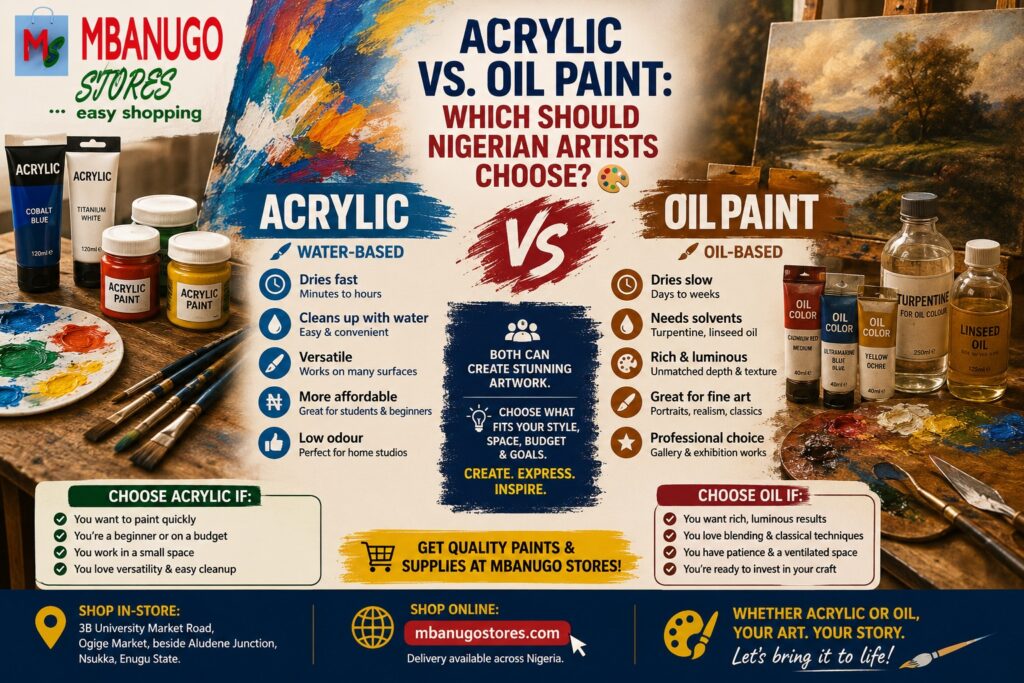
If you’ve spent any time in the art world — whether you’re a student at UNN’s fine arts department, a self-taught artist building your craft, or someone who just discovered they can actually paint and wants to go deeper — you’ve probably faced this question at some point:
Acrylic or oil paint? Which one should I use?
And if you’ve ever tried Googling it, you’ve probably found answers written for artists in the UK or US — talking about studio conditions, temperature-controlled rooms, and art supply shops that don’t exist in Nigeria.
This post is different. This is the acrylic vs. oil paint breakdown written specifically for Nigerian artists — with our climate, our budget realities, our living and studio conditions, and our creative goals in mind.
Let’s settle this once and for all. 🔥
First — What’s the Actual Difference?
Both acrylic and oil paint are used to create stunning, professional-quality artwork. Both can be applied to canvas, board, and paper. Both have been used to create some of the most celebrated paintings in art history.
But under the surface, they are fundamentally different materials — and those differences matter enormously depending on who you are and how you work.
Here’s the core distinction:
Acrylic paint is water-based. It dries quickly — sometimes within minutes — and becomes water-resistant once dry. It’s made with pigment suspended in an acrylic polymer emulsion.
Oil paint is oil-based. It dries very slowly — sometimes taking days, weeks, or even months to fully cure. It’s made with pigment suspended in a drying oil, usually linseed oil.
Simple enough. But the implications of those two differences — water vs. oil, fast-drying vs. slow-drying — ripple through every single aspect of how you paint, how you work, and what kind of results you get.
Let’s break it down properly.
🔵 ACRYLIC PAINT — Everything You Need to Know
How It Works
Acrylic paint comes straight out of the tube (or pot) ready to use. Thin it with water for washes and transparent effects. Use it thick straight from the tube for bold, textured strokes. Mix it with acrylic mediums to extend drying time, add gloss or matte finish, or create special texture effects.
It dries to a flexible, plastic-like finish that is water-resistant, durable, and long-lasting.
Drying Time
Fast. Very fast. Depending on how thickly you apply it and how hot and dry the environment is — acrylic can dry in minutes. A thin wash can be touch-dry in 5–10 minutes. A thick application may take an hour or two.
What You Can Do With Acrylics
✅ Thin washes and watercolour-like effects
✅ Bold, opaque, thick impasto painting
✅ Layering and overpainting quickly
✅ Mixed media work
✅ Street art and murals
✅ Illustration and graphic art
✅ Painting on canvas, board, paper, wood, fabric, walls
Pros of Acrylic Paint
👍 Dries fast — You can layer, overpaint, and correct mistakes quickly without waiting days
👍 Easy to clean — Brushes and palettes clean up with just water (while still wet)
👍 Versatile — Works on almost any surface with minimal preparation
👍 Affordable — Generally less expensive than oil paints of comparable quality
👍 Low odour — No need for special ventilation or solvents
👍 Beginner-friendly — Forgiving, flexible, and easy to work with from the start
👍 Durable finish — Once dry, extremely resistant to cracking and water damage
Cons of Acrylic Paint
👎 Dries too fast — In Nigeria’s hot climate, acrylics can dry on your palette and brush faster than you want, making blending challenging
👎 Colour shift — Acrylics often dry slightly darker than they appear when wet — takes getting used to
👎 Less luminosity — The finished surface, while vibrant, doesn’t quite achieve the deep, glowing luminosity of oil paint
👎 Can look plastic — If applied incorrectly, acrylic paintings can look flat or artificial
🟡 OIL PAINT — Everything You Need to Know
How It Works
Oil paint comes from the tube thick and rich. You thin it with solvents (like turpentine or mineral spirits) for transparent glazes and loose work. For thicker application, use it straight from the tube or with linseed oil to improve flow and gloss.
Oil paint dries through oxidation — a chemical process where the oil reacts with air — rather than simple evaporation. This is why it takes so much longer to dry.
Drying Time
Slow. Very slow. A thin layer of oil paint may be touch-dry in 1–3 days. Thick applications can take weeks. A fully cured oil painting — where the paint has hardened all the way through — can take 6 months to a year.
What You Can Do With Oil Paint
✅ Rich, luminous, deeply layered paintings
✅ Subtle, smooth colour blending
✅ Portrait and figurative work
✅ Fine detail and realistic rendering
✅ Classical painting techniques (glazing, scumbling, wet-on-wet)
✅ Large-scale exhibition and gallery work
Pros of Oil Paint
👍 Incredible luminosity — Oil paint has a depth and richness of colour that is unmatched by any other medium
👍 Slow drying = easy blending — You have time to blend, adjust, and refine your work on the canvas
👍 Rich texture — Thick oil paint has a buttery, sensuous quality that creates beautiful textural effects
👍 Long working time — You can work on a painting over multiple sessions without the paint drying between sessions
👍 Classic and prestigious — Oil painting is the medium of the masters. There is a depth and gravitas to an oil painting that carries cultural weight
👍 Colour stays true — What you see when you mix is largely what you get when it dries
Cons of Oil Paint
👎 Slow drying — Waiting days or weeks between layers requires serious patience and planning
👎 Requires solvents — Cleaning up requires turpentine or mineral spirits, which are smelly, toxic with prolonged exposure, and an added expense
👎 Needs ventilation — You should not paint with oils in an enclosed, poorly ventilated space
👎 More expensive — Quality oil paints and the associated materials (solvents, mediums, primers) cost more than acrylics
👎 More preparation — Surfaces often need proper priming (gesso) before oil painting to prevent the oil from damaging the support over time
👎 Less forgiving — Mistakes take longer to correct since you can’t just overpaint immediately
🇳🇬 The Nigerian Factor — What Our Climate Does to Your Paint
Here is the section that most painting guides completely ignore — and for Nigerian artists, it’s one of the most important considerations of all.
Nigeria is hot. Nigeria is humid (especially during rainy season). And Nigeria gets serious dry heat during harmattan.
Both of these conditions significantly affect how your paint behaves.
How Nigeria’s Climate Affects Acrylic Paint
Our heat is both a friend and an enemy to acrylic painters.
The friend: Acrylics dry fast — and Nigeria’s heat makes them dry even faster. If you love working quickly, building layers rapidly, or finishing a painting in one sitting, Nigeria’s climate actually accelerates your process.
The enemy: That same heat will dry acrylic paint on your palette and your brush in minutes if you’re not careful. You’ll be mixing a colour and turn around to find it has already skinned over. To manage this:
- Use a stay-wet palette (a palette with a damp sponge layer that keeps paint moist)
- Work in a slightly cooler part of your space when possible
- Keep a fine spray bottle of water nearby and mist your palette regularly
- Work with smaller amounts of paint at a time and mix fresh as needed
During rainy season: High humidity can slow acrylic drying time slightly — which is actually a bonus for blending.
How Nigeria’s Climate Affects Oil Paint
This is where Nigerian artists who use oils need to pay close attention.
The good news: Nigeria’s heat can slightly accelerate the touch-drying of thin oil paint layers — which is a small advantage over colder climates where oil paint can take even longer to dry.
The challenge: Our humidity during rainy season can introduce moisture into your painting process — and oil and water do not mix well. Paint applied in high humidity conditions may not cure evenly. Ensure you’re working in a well-ventilated but not damp environment.
Harmattan is actually ideal for oil painting — The dry air and moderate temperatures create near-perfect conditions for oil paint application and drying. Many Nigerian oil painters find their best working season is harmattan.
The solvent situation: Turpentine and mineral spirits — essential for oil painting — can be harder to source in some Nigerian cities and towns, and their fumes are stronger in enclosed, hot spaces. Ensure proper ventilation, especially during hot months.
💰 Budget Reality — What Does Each Cost in Nigeria?
Let’s be real about money, because it matters.
Acrylic paint is generally more affordable and accessible for Nigerian artists. Student-grade acrylics are available at reasonable prices, and because they’re water-based, the only additional materials you need are brushes, a palette, water, and a surface. Low barrier to entry.
Oil paint is more expensive at every level — the paints themselves cost more, plus you need solvents (turpentine/mineral spirits), linseed or other painting oils, and proper canvas primed for oils. The ongoing cost of solvents adds up significantly over time.
Verdict for budget-conscious artists: Start with acrylics. Build your skills, earn from your work, and invest in oils when you’re ready and your income supports it.
🏆 Head-to-Head: Acrylic vs. Oil for Nigerian Artists
| Factor | Acrylic | Oil |
|---|---|---|
| Ease for beginners | ✅ Excellent | ⚠️ Moderate |
| Drying time | ✅ Fast (mins–hours) | ❌ Slow (days–weeks) |
| Blending ease | ⚠️ Challenging in heat | ✅ Excellent |
| Luminosity / depth | ⚠️ Good | ✅ Outstanding |
| Cleanup | ✅ Water only | ❌ Needs solvents |
| Ventilation needed | ✅ Minimal | ❌ Essential |
| Cost / affordability | ✅ Lower | ❌ Higher |
| Versatility of surfaces | ✅ Very high | ⚠️ Moderate |
| Works in Nigerian heat | ✅ Yes (with care) | ⚠️ Yes (with planning) |
| Professional / gallery use | ✅ Yes | ✅ Yes |
| Classic painting techniques | ⚠️ Limited | ✅ Excellent |
🎯 So — Which Should You Choose?
Choose Acrylic Paint if:
- You’re a beginner or intermediate artist still building your skills
- You want to paint quickly and layer without waiting days between sessions
- You’re on a budget and want maximum results for minimum spend
- You work in a small, enclosed space without much ventilation
- You paint on a variety of surfaces — canvas, wood, fabric, murals
- You create illustration, graphic, or commercial art
- You want easy cleanup without chemicals
Choose Oil Paint if:
- You’re a more advanced artist ready to invest in deeper technique
- You love portrait, figurative, or highly realistic painting
- You have a well-ventilated studio or workspace
- You have the patience and planning to work with slow drying times
- You want the deep luminosity and rich texture that oil uniquely provides
- You’re creating serious gallery and exhibition work
- You can source quality solvents and are comfortable using them safely
The honest truth? Most serious Nigerian artists end up using both — acrylics for fast studies, practice, murals, and commercial work, and oils for major exhibition pieces and fine art. Start where your budget and skill level are right now, and grow from there.
Where to Buy Acrylic and Oil Paints in Nsukka
Whether you’ve made your choice or you want to try both, MBANUGO Stores has you covered with quality paints for every level and budget.
In stock at MBANUGO Stores:
- Acrylic paints — student and artist grade, in a wide range of colours
- Oil paints — quality options for serious painters
- Canvas boards and stretched canvases
- Painting brushes — from fine detail to broad stroke
- Palettes, palette knives, and painting mediums
- Sketchbooks and watercolour paper
- And everything else your art practice needs
🏪 Walk Into the Store:
📍 3B University Market Road, Ogige Market,
beside Aludene Junction, Nsukka, Enugu State.
Come in and describe your project, your experience level, and your budget. The team at MBANUGO Stores will help you choose the right paint, the right surface, and the right tools for exactly what you want to create.
📱 Order Online — Delivery Anywhere in Nigeria:
🌐 mbanugostores.com
Can’t make it to Nsukka? No wahala. Browse the full art supplies range at mbanugostores.com and order with delivery to your door anywhere in Nigeria.
Final Word — The Best Paint Is the One You Actually Use 🎨
Every debate about acrylic vs. oil ultimately comes down to this: the best paint for you is the one that fits your current skill level, your working style, your environment, and your budget — and that you will actually pick up and use consistently.
Don’t let the decision paralyse you. Start where you are. Use what you can access. Improve as you go. And trust that Nigerian artists — with our talent, our stories, and our unique perspective — can create world-class work with any medium we choose.
Head to MBANUGO Stores at Ogige Market, Nsukka or visit mbanugostores.com and get the paints that will bring your next piece to life.
Now go create something the world needs to see. 🔥🎨
📍 Visit us: 3B University Market Road, Ogige Market, beside Aludene Junction, Nsukka, Enugu State
🌐 Shop online: mbanugostores.com
Know a Nigerian artist who’s been going back and forth on this question? Share this post — it was written for them. 🎨🔁